Introduction
Corgea CLI is a powerful developer tool that helps you find and fix security vulnerabilities in your code. Using our AI-powered scanner (BLAST) and platform, Corgea identifies complex security issues like business logic flaws, authentication vulnerabilities, and other hard-to-find bugs. The CLI provides commands to scan your codebase, inspect findings, interact with fixes, and much more - all designed with a great developer experience in mind.Features
- Multiple Scanner Support: Scan with BLAST (our AI-powered scanner), and upload reports from Semgrep, Snyk, Checkmarx, CodeQL, Fortify, and Coverity.
- Issue Management: List, inspect, and manage security findings.
- Fix Integration: View and apply AI-generated fixes for vulnerabilities right from your terminal.
- Dependency Scanning: Build offline dependency inventories, inspect dependency graphs, generate SBOMs, and evaluate dependency policy with
corgea deps. - Container Image Scanning: Scan fully built container images alongside your code with
corgea scan --include-image. - Package Advisory Checks: Look up known advisories before selecting or installing an npm or PyPI package.
- Package Manager Install Gate: Vet
npm,yarn,pnpm,pip, anduvinstalls for known-vulnerable, malicious, or suspiciously fresh packages before they land — see Package Manager Install Gate. - Flexible Output: Support for both human-readable and JSON output formats for easier CI integrations.
- CI/CD Integration: Fail builds based on severity levels or custom blocking rules.
- Scan Management: Track scan progress and results across your projects.
- Agent Skill Installation: Install approved agent skills from the Corgea registry into supported coding agents.
- MCP Server Installation: Write the Corgea MCP server into supported coding agents with
corgea mcp install. - Incremental Scans: BLAST scans analyze only changed files by default (CLI 1.12.0 or later). Use
--disable-incrementalto analyze every file.
Prerequisites
- Corgea account: An active Corgea account.
- Token for authentication: A valid Corgea API token or JWT access token.
corgea deps scan, graph, explain, diff, sbom, and policy init commands do not require a Corgea account, token, configuration, or network access.
Installation Guide
Install with npm
Install with uv
For Python users, this is the preferred installation method.uv tool install creates an isolated tool environment from the PyPI package and exposes the CLI as corgea on your PATH.
uv reports that its tool directory is not on your PATH, run:
Install with pip
If you do not useuv, you can install the Corgea CLI with Python’s package installer, pip:
Install with Homebrew
To install the Corgea CLI tool using Homebrew, first add the Corgea tap and then install the CLI:Install Manually
Download the archive for your platform from GitHub Releases, unzip it, and move thecorgea binary onto your PATH. Release archive names now include the version. The examples below install v1.16.1; to install another release, replace the version in both the URL and filename.
corgea-v1.16.1-x86_64-unknown-linux-musl.zip and corgea-v1.16.1-aarch64-unknown-linux-musl.zip; use these for minimal containers and CI runners.
Authentication
Login with your cli
To authenticate with the CLI, use the following command. This will redirect you to the web application to authorize the CLI:Login with custom scope (for customers with Single-Tenant Instance)
Hint: Your company scope is the Corgea subdomain, for example:https://your-company.corgea.app
Login with token (API token or JWT)
For automated pipelines and CI/CD environments, use token authentication for a reliable, non-interactive login flow. You can pass either a Corgea API token or a JWT access token:Point To A Single-Tenant Instance
Customers using a single-tenant or regional instance (for examplehttps://eu.corgea.app) need to configure the CLI to point to their specific instance using the --url option:
Usage
Commands and Options
Check Package Advisories
Usecorgea advisories check to review known advisories before choosing or installing an npm or PyPI package. A package-only check lists its advisory history; add an exact version to get a verdict for that release.
npm or pypi (pip is also accepted as an alias). npm versions must use a complete, exact version such as 1.2.3; ranges, tags, and partial versions are not supported. PyPI checks accept either package@version or pip-style package==version syntax.
Package-only results help you review advisory history before selecting a version. Exact-version results include known advisory details, fixed-version information when available, and a safe-version recommendation when all reported advisories have fixes. This command is read-only and requires network access; the package manager install gate remains the enforcement step.
Use --json for a machine-readable schema version 1 response. The command exits with code 0 when no advisories are found, 1 when advisories are found, and 2 for an error. A package not present in the advisory database exits with code 0.
Package Manager Install Gate
Usecorgea npm, corgea yarn, corgea pnpm, corgea pip, or corgea uv to run supported package-manager install commands through Corgea before dependencies are installed.
corgea pip --force install requests.
Recency gate. Beyond vulnerability data, Corgea blocks any named install target whose resolved version was published within a recency window — catching just-shipped typosquats and hijacks before advisory feeds catch up. It is on by default with a 14-day window. Configure it in
~/.corgea/config.toml (recency_gate = false to disable, recency_threshold_days to retune the window), or with the CORGEA_RECENCY_GATE and CORGEA_RECENCY_THRESHOLD_DAYS environment variables. Packages whose publish date can’t be determined never trip the gate, a vulnerable or malicious verdict takes precedence over freshness, and --force bypasses it for a single install.
Coverage. pip install and npm install resolve the full would-install set, including transitive dependencies, so a vulnerable transitive dependency blocks the command; if the dry-run resolver fails, Corgea warns and falls back to named-target checks. npm ci is gated from the project lockfile and uv sync from uv.lock, so the full locked set is checked even though those commands name no packages. The uv gate also covers named uv add ... and uv pip install ... targets, while uv lock passes through because it installs nothing. yarn and pnpm check named targets only — they have no safe dry-run resolver.
Bare installs. Bare npm install is gated from the project’s package.json. Bare yarn, pnpm, and install-shaped uv commands cannot be checked first, so Corgea prints a note and runs them unchecked.
CORGEA_TOKEN or corgea login on the default vulnerability API, the gate runs in authenticated mode and fails closed — unverifiable packages, dependency-resolution failures, vulnerability-API outages, and degraded tree coverage on managers that normally resolve the full tree (pip, npm, uv) block the install unless you pass --force.
Custom vulnerability API. If you point CORGEA_VULN_API_URL at a custom endpoint, Corgea does not send your token there, so the gate stays in public mode. Set CORGEA_VULN_API_SEND_TOKEN_TO_CUSTOM_URL=1 to enable authenticated enforcement against an endpoint you trust.
Externally managed Python. For pip, Corgea refuses installs into externally managed environments (PEP 668) before registry checks run. Activate a virtual environment, or pass --force to bypass.
Corgea runs the matching package manager from your PATH. For corgea pip ..., it tries pip3 when pip is missing; if neither exists, the CLI exits 127 and names the missing binary.
Non-install commands and flags are forwarded to the package manager. For example, corgea npm --version reports the installed npm version, while corgea --version reports the Corgea CLI version.
Findings. When a resolved package is vulnerable, tree findings show its origin:
(from requirements)— requested through a pip requirements file.(already in package.json)— already a direct npm dependency.(transitive)— pulled in through another dependency.
safe version: axios@0.21.2, and for vulnerable direct npm dependencies it may print fix with: corgea npm install package-name@version (advertised fix). Vulnerability counts and exit behavior follow the original install target.
JSON output. --json returns one report on stdout and writes resolution and package-check progress to stderr, keeping stdout available for machine-readable output. The package manager’s stdout is also redirected to stderr. Schema version 2 reports manager, subcommand, args, recency_threshold_days (the active recency window, or null when the gate is off — pair it with each result’s age_seconds), a summary split into named and tree counts, verdict_mode, a results array, and a tree object when tree resolution ran. Tree entries carry an origin of requested, pre-existing, or transitive. Known-malicious packages report a distinct verdict status of malicious, a per-match malware boolean, and a separate malicious count in each summary object. Their remediation is always null because the package should be removed rather than upgraded; vulnerable verdicts continue to report a safe version only when it covers every advisory.
Install Agent Skills
Install an approved skill from the Corgea registry into your coding agent’s skills directory:cursor, claude-code, codex, github-copilot, gemini-cli, windsurf, opencode, and universal. Use --scope project to install into the current repository, --scope user to install for your user account, or --dir to install into a custom skills directory.
To install a specific version, append it to the skill name:
--set-default, which persists the --agent value you passed:
CORGEA_DEFAULT_AGENT environment variable overrides the saved default, which is useful in CI where you do not want to write to the config file.
Install MCP Server
Write the Corgea MCP server into a coding agent’s config using the URL and token already stored bycorgea login (CLI 1.13.0 or later):
npx. For a single-tenant instance, pass --url:
--url:
cursor, claude, claude-code, windsurf, vscode, gemini-cli, continue, and opencode. Aliases include claude-desktop, vs-code, github-copilot, copilot, gemini, and open-code. Use --scope user (the default) or --scope project. Claude Desktop has no project-level MCP config. --dir writes to a custom path, and --set-default persists the --agent value like corgea skill install.
Reinstalling replaces the existing Corgea entry so the URL and token stay current. Neighboring servers are left intact. A project-scope install writes the token into the file — do not commit it.
Restart the agent after installing so it loads the new server. See Model Context Protocol (MCP) for client-specific notes and available tools.
Upload a Scan Report
Upload a scan report to Corgea via STDIN or a file (JSON, SARIF, FPR, or Coverity XML):corgea upload from the directory that contains your source files, usually the repository root. In CLI 1.14.0 and later, third-party scan report uploads automatically include corgea.yaml and corgea.yml policy files from the current directory and its subdirectories, even if the report does not reference them. Policy files in the current directory are included even when Git ignores them; nested files follow the usual ignore rules. Symbolic links are not included.
For Fortify FPR reports, source uploads use the files where findings are reported. Bundled library files that appear only as enclosing context no longer prevent an upload when those source files are present locally.
To control the project name shown in Corgea for uploaded reports, use --project-name. If omitted, the CLI defaults to the git repository name when available, and falls back to the current directory name.
--wait to wait for processing to finish and print the results:
Scan Your Codebase
To scan your current directory using the default BLAST scanner:git status does. Scans that include uncommitted changes analyze your local files even when the current commit SHA has not changed. Ignored or equivalent files do not force a full scan or mark worktree_dirty.
BLAST scans (CLI 1.12.0 or later) are incremental by default. Corgea analyzes changed files and carries existing findings forward for everything else. The full project is still uploaded so unchanged files remain available as context. See Incremental Scans for how the baseline is chosen, and for --exclude and --disable-incremental.
To specify a different scanner, such as Semgrep:
--fail-on (BLAST scans only) with one or more comma-separated conditions: CR, HI, ME, LO, or malicious. Severity conditions match findings at that severity or higher; for example, ME also matches HI and CR findings. The malicious condition matches a dependency finding classified as malicious. The command exits with a non-zero status when any listed condition matches.
Examples:
--fail-on ME fails on ME, HI, or CR findings. When multiple conditions are listed, the scan fails if any condition matches. A vulnerable dependency that is not classified as malicious does not match the malicious condition.
Or fail based on every active blocking rule defined in the web app, regardless of whether each rule applies to pull requests or CI:
--fail is deprecated in CLI 1.10.0 and later. Prefer --block-on to name the CI rules a pipeline should enforce.
To enforce specific rules in a CI pipeline, set each rule’s Applies To target to CI in the web app and pass the generated slug to --block-on (CLI 1.10.0 or later):
criticals,malicious-deps. Only active CI rules can be used; an unknown slug, inactive rule, or pull request rule causes the command to fail with a configuration error. --block-on is supported only by the BLAST scanner and cannot be combined with --fail or --fail-on. --fail and --fail-on also cannot be used together.
Blocking rules are evaluated in the Corgea cloud, so the command waits for that to finish — up to 35 minutes. If the wait runs out it exits 1 rather than letting an unevaluated scan through. Set CORGEA_BLOCKING_RULES_TIMEOUT_SECONDS to the number of seconds to wait instead:
--out-file report and --sbom output before exiting.
By default, the scan command scans the entire project. However, if you only want to scan your changes before committing, you can use the —only-uncommitted option.
--target option. This accepts comma-separated values and supports file paths, directory paths, glob patterns, git selectors, or stdin.
Examples:
--exclude option. This accepts comma-separated glob patterns and can be used with or without --target.
--only-uncommitted and --target cannot be used together.
To skip files during a BLAST scan, use --exclude with comma-separated glob patterns. It can be combined with --target to scan a subset while excluding matches within it.
--project-name. If omitted, the CLI defaults to the git repository name when available, and falls back to the current directory name.
--metadata with KEY=VALUE pairs. These values are included with the scan and in JSON scan-list output.
--metadata is supported only by the BLAST scanner. Each entry must have a non-empty key; if the same key is supplied more than once, the last value is used.
In the Corgea web app, scan metadata appears as read-only labels on the Scans page, scan details, and issue details.
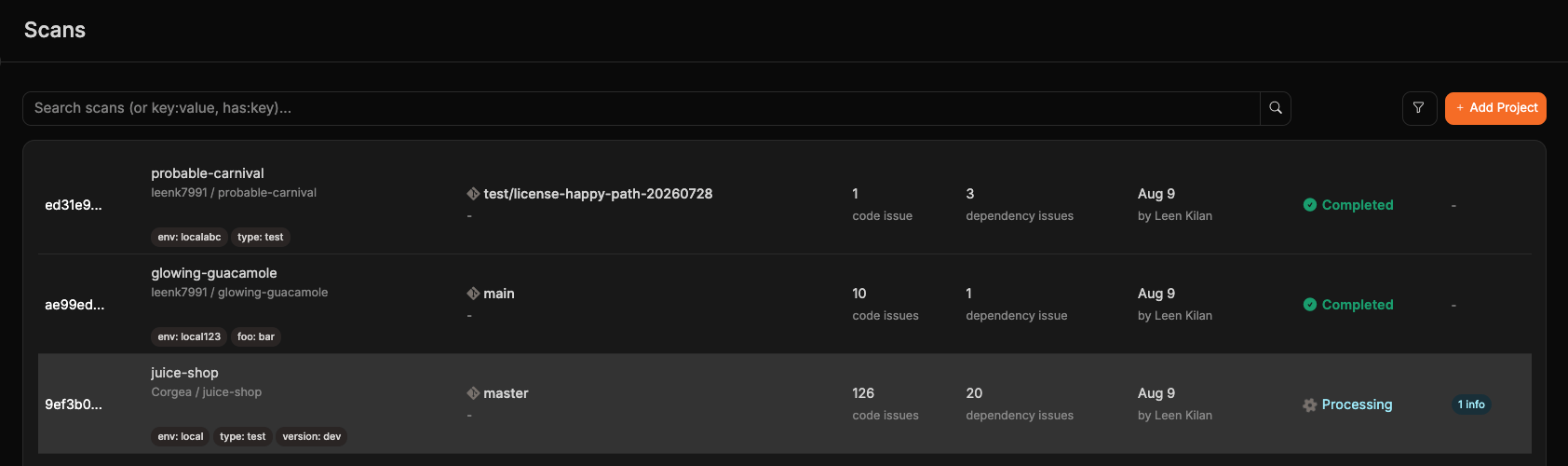
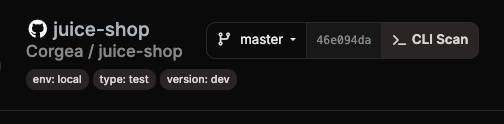
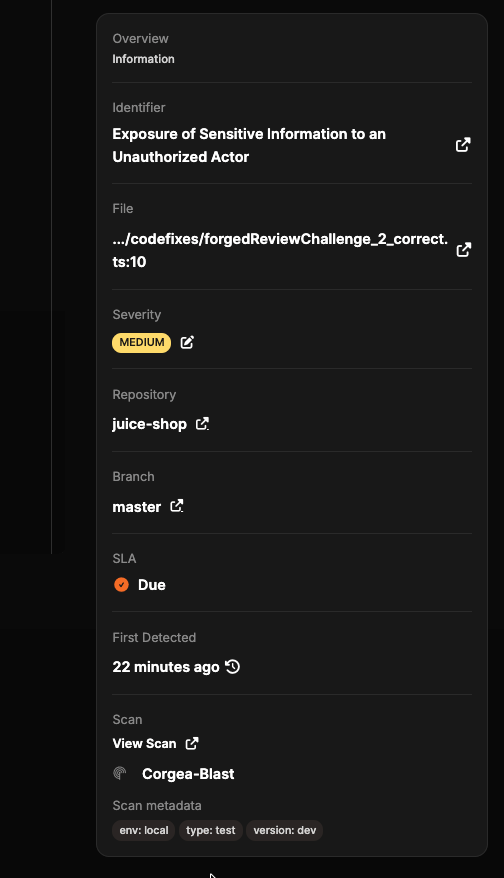
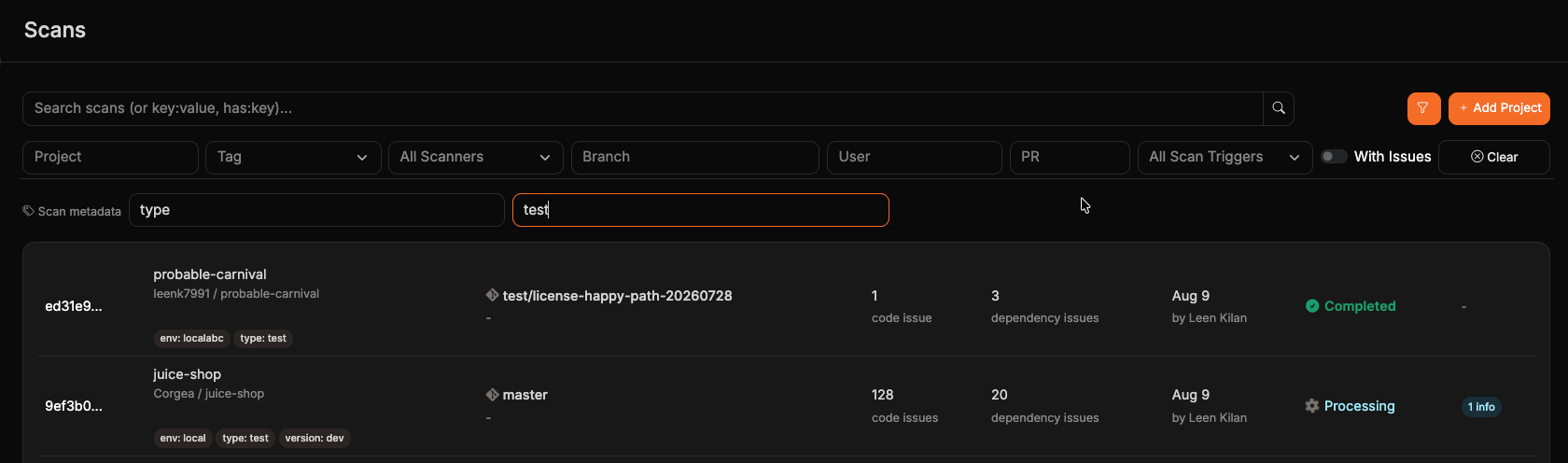
has:key and key:value, for example has:pipeline_url or environment:production.

- Blast Base AI Scan
- PolicyIQ Scan
- Malicious Code Detection Scan
- Secrets Detection Scan
- Personally identifiable information (PII) Detection Scan
--scan-type and --policy apply only to BLAST scans. Passing --policy without --scan-type policy still runs the other BLAST scan types and prints a warning.
Scan Container Images
By default, Corgea discovers the images your project references inDockerfile and Docker Compose files. To scan a fully built image instead — for example one you just built in CI that has never been pushed to a registry — pass it with --include-image:
--include-image, Corgea scans the images you provide instead of searching your source tree for base images.
Requirements and behavior:
- Container scanning must be enabled for your account.
dockerorpodmanmust be available on yourPATH. Corgea uses whichever it finds first; setCORGEA_CONTAINER_ENGINEto choose explicitly.- An image that is not available locally is pulled first, so images from a private registry work as long as your container engine is already authenticated to it.
--include-imageis supported only by the BLAST scanner.
Export Scan Report
The Corgea CLI allows you to export scan results to a file, which is particularly useful when running the tool within a CI pipeline. You can do this using the —out-format and —out-file options.--sbom to generate a CycloneDX SBOM after the scan completes. The default file is bom.json, or you can provide a path:
--fail and --block-on are evaluated. A scan that exits with a non-zero status because a blocking rule tripped still leaves its report and SBOM on disk, so a later CI step can always ingest them.
Force-Including Files
In CLI 1.16.1 and later, use the repeatable--include flag with the BLAST scanner to force a file, directory, or glob pattern into the scan when Corgea would otherwise skip it as vendored, third-party, generated, or test code. For example:
.gitignore, --exclude, and Corgea’s code classification. Matching files are analyzed on every run, including incremental scans. Project rules configured under File Include Rules in scan settings apply automatically; --include adds rules for the current run. The CLI prints the paths it force-includes. Choose specific paths: whole-repository patterns such as **, *, and /** are rejected. At most 5,000 matching files are force-included per run; the CLI warns if this limit is exceeded.
Incremental Scans
BLAST scans are incremental by default. Corgea uploads the whole project but analyzes only files changed since the selected baseline scan; unchanged files keep their existing findings, so the result still represents the full project. With CLI 1.15.0 or later and a suitable prior scan with stored file checksums, incremental scans work in shallow clones, detached HEAD checkouts, and directories without Git history, including extracted archives. Uncommitted changes are included automatically. If stored checksums are unavailable, the CLI falls back to Git when possible; otherwise, it scans every file and explains why. It also skips incremental behavior when--only-uncommitted or --target narrows the upload. In CLI 1.16.0 or later, --exclude still allows incremental analysis when a suitable prior scan has usable stored file checksums. Otherwise, the CLI analyzes every included file and explains why; excluded files remain excluded.
With CLI 1.16.0 or later, newly excluding files with --exclude removes their previous findings from the new scan results. Removing an exclusion causes those files to be analyzed again when they are included in the upload.
With CLI 1.16.2 and later, Corgea first uses a suitable scan of the nearest commit among the 20 most recent commits in the checkout, regardless of branch name. If none is found, it uses a suitable scan of the current branch, then the default branch recorded by this clone, then main or master. Detached HEAD checkouts are included. Only history present in the local clone is searched.
Use --disable-incremental to force BLAST to analyze every file, for example after changing scanner configuration outside corgea.yaml:
--ignore-dirty-worktree allows an incremental scan that includes modified and untracked files. This flag is not required for incremental scans using stored file checksums.
Reuse a Recent Scan of the Same Commit
A pipeline that re-runs on an unchanged commit can reuse the scan Corgea already has instead of paying for a duplicate. Add--skip-if-commit-scanned-recently to a BLAST scan:
--block-on gate and its exit code, and any --out-file report all come from it. The pipeline behaves the same whether or not a scan actually ran.
Use --scanned-within to set the window. It is only valid with --skip-if-commit-scanned-recently. It accepts values such as 90s, 30m, 24h, and 7d, and reads a bare number as hours. The default is 24h, because unchanged code is still exposed to advisories published since it was last scanned.
worktree_dirty=true, pass --ignore-dirty-worktree (CLI 1.11.1 or later). A new scan still reports the real dirty status to Corgea.
CORGEA_SCAN_SKIPPED=true along with CORGEA_SCAN_ID=<id> when it reused a scan, and CORGEA_SCAN_SKIPPED=false when a scan ran. These lines are stdout markers, not environment variables. They are not printed if the command exits because the current commit cannot be resolved. If the reuse check cannot reach the API, the CLI warns and runs a new scan.
What can be reused. Corgea only reuses a scan that answers the same question, which is stricter than matching the commit. A candidate must be a completed BLAST scan of the current commit, run on a branch rather than a pull request, from a clean worktree, with no scanner problems reported. Anything else runs a real scan — nothing inside the window, a failed or still-running scan, or a worktree that does not match the commit. --ignore-dirty-worktree overrides the dirty-worktree half of that test: reuse proceeds if this worktree is dirty or the prior scan recorded worktree_dirty=true. A prior scan that never reported the flag is still not reused, because its scope is unknown.
Options that cannot be combined. No API reports how an earlier scan was scoped, so --skip-if-commit-scanned-recently cannot be combined with --only-uncommitted, --target, --scan-type, --policy, --include-image, --include, or --disable-incremental, and the command fails if you pass one of them. --exclude is allowed but prints a warning when a scan is reused: the reused scan covers files this run would have skipped, so results can over-report, never under-report.
Project include rules, or a failed lookup of those rules, also prevent reuse: the CLI runs a new scan and prints CORGEA_SCAN_SKIPPED=false.
If the current commit cannot be resolved — the directory is not a git repository, or the repository has no commits yet — the command exits with a non-zero status instead of silently running a full scan.
When a scan is reused, --sbom still reflects the current workspace rather than the reused scan’s earlier SBOM.
Dependency Inventory
Usecorgea deps to build an offline dependency inventory from npm, Python, and Java manifests and lockfiles. The command evaluates dependency pinning policy, can fail CI based on findings, and does not require login or network access.
--format human, agent, json, or quiet to control terminal output for scan, graph, explain, diff, and policy init. In detected agent environments, corgea deps defaults to the compact agent format; pass --format human to force normal terminal output.
For corgea deps scan, use --out-format table, json, or sarif with optional --out-file when exporting a report. Do not combine --format and --out-format on the same deps scan command.
To customize dependency policy, initialize .corgea/deps.yml:
latest, or semver ranges are reported. See Dependency Scanning for CI examples, policy configuration, and troubleshooting.
Wait for a Scan
To wait for the latest in-progress scan:corgea wait, corgea scan, and corgea upload --wait exit 1 if the scan fails, printing the reason and any scanners that reported a problem. A scan that finishes with one scanner’s results missing exits 0 with a warning.
Waiting stops after 10 hours, so a scan that never reports a final status cannot hold a CI job open indefinitely. On timeout the command exits with code 1. The scan itself keeps running in the Corgea cloud. If your scans need longer, set CORGEA_SCAN_TIMEOUT_SECONDS to the number of seconds to wait:
--repo org/repo (or a repository URL) to resolve a different repository, or --project-name to query an exact Corgea project name. If you already know both IDs, corgea wait SCAN_ID --project-id PROJECT_ID skips project resolution.
corgea scan, corgea wait, and corgea upload --wait all exit with a non-zero status when a scan fails, printing the reason and naming any scanners that hit problems. A scan that completes with a scanner missing exits 0 with a warning instead.
Waiting gives up after 10 hours; set CORGEA_SCAN_TIMEOUT_SECONDS to change that budget. When --fail or --block-on is used, the CLI then waits up to 35 minutes for blocking rules to be evaluated; set CORGEA_BLOCKING_RULES_TIMEOUT_SECONDS to change that one.
List Scans, Security Issues, SCA Issues, or Code Quality Issues
To list all scans for a current directory (paginated by default):--json option is available for commands like list and inspect to output results in JSON format, which is useful for integrations and automation.
N/A when no SHA is available. JSON output includes the complete git_sha value, the nullable worktree_dirty value, and any scan metadata returned by Corgea. worktree_dirty is true when the scan included uncommitted local changes and can be null for scans created by older CLI versions.
To list SCA issues for a project or scan, use --sca-issues or the -c shorthand. The table includes each issue’s classification, and JSON output includes the classification field when provided.
--code-quality (or --quality/-q). Like the other issue modes, it can be limited to a scan with --scan-id.
--repo org/repo (or a repository URL) to select another repository, or --project-name to query an exact Corgea project name.
Inspect a Scan or Issue
To inspect a specific scan:corgea inspect --issue ISSUE_ID and corgea inspect --issue --summary ISSUE_ID show a Scanner Metadata section when the scanner stored identifiers. Fortify findings can include instance_id, class_id, kingdom, category, analyzer, and build_id. The text view merges issue.metadata (identifiers from the scanner that reported the finding) and issue.scanner_metadata (the copy stored for fix analysis). When the same key appears in both, the scanner’s own value is shown, and empty values are left out. With --json, the two objects stay separate.
For fix explanations or diffs:
Integrating with GIT Hooks
To ensure code quality and security, you can integrate Corgea CLI with your Git workflow using pre-commit hooks. This feature allows you to scan your code changes before committing or pushing them. To set up the pre-commit hook, simply runEnvironment Variables
Automatic Rate Limit and Gateway Retries
In CLI 1.14.1 and later, Corgea API calls made by the CLI automatically retry429 Too Many Requests responses for all requests, including uploads (POST and PATCH). 502 Bad Gateway responses are retried only for read requests; writes fail without retrying the response to avoid creating duplicate scans.
In CLI 1.16.1 and later, 504 Gateway Timeout and Cloudflare 520–524 responses follow the same retry behavior as 502 Bad Gateway: read requests are retried, while writes fail without retrying the response to avoid duplicate scans.
The CLI retries up to three times per request, waiting 10, 30, and 50 seconds before successive retries. Each retry is logged. For a 429 response with a Retry-After value in seconds, the CLI extends the wait if needed, up to two minutes per pause, without shortening the scheduled delay. If the error persists, the request fails and the command handles the failure as usual.
If a source file upload during corgea upload receives a gateway error (502, 504, or 520–524), or still receives 429 Too Many Requests after all retries, the CLI stops uploading the remaining source files and reports them as unsent.
Debug Mode
To enable debug logs, setCORGEA_DEBUG=1 before running a command.