> ## Documentation Index
> Fetch the complete documentation index at: https://docs.corgea.app/llms.txt
> Use this file to discover all available pages before exploring further.
# Corgea Agent
> AI-powered assistant for managing security vulnerabilities in your codebase
## Overview
Corgea Agent is an AI-powered assistant that helps you manage security vulnerabilities in your codebase. It provides two main interaction modes:
1. **Web Chat Interface** - An interactive chat for exploring security issues, scans, and vulnerability data
2. **Pull Request Comments** - Automated responses to commands in PR comments across GitHub, GitLab, Azure DevOps, and Bitbucket
***
## Getting Started
### Prerequisites
Before enabling Corgea Agent, ensure you have:
* Active Corgea account with appropriate plan access
* At least one integration configured (GitHub, GitLab, Azure DevOps, or Bitbucket)
* Webhook events properly configured for your repository
### Initial Setup
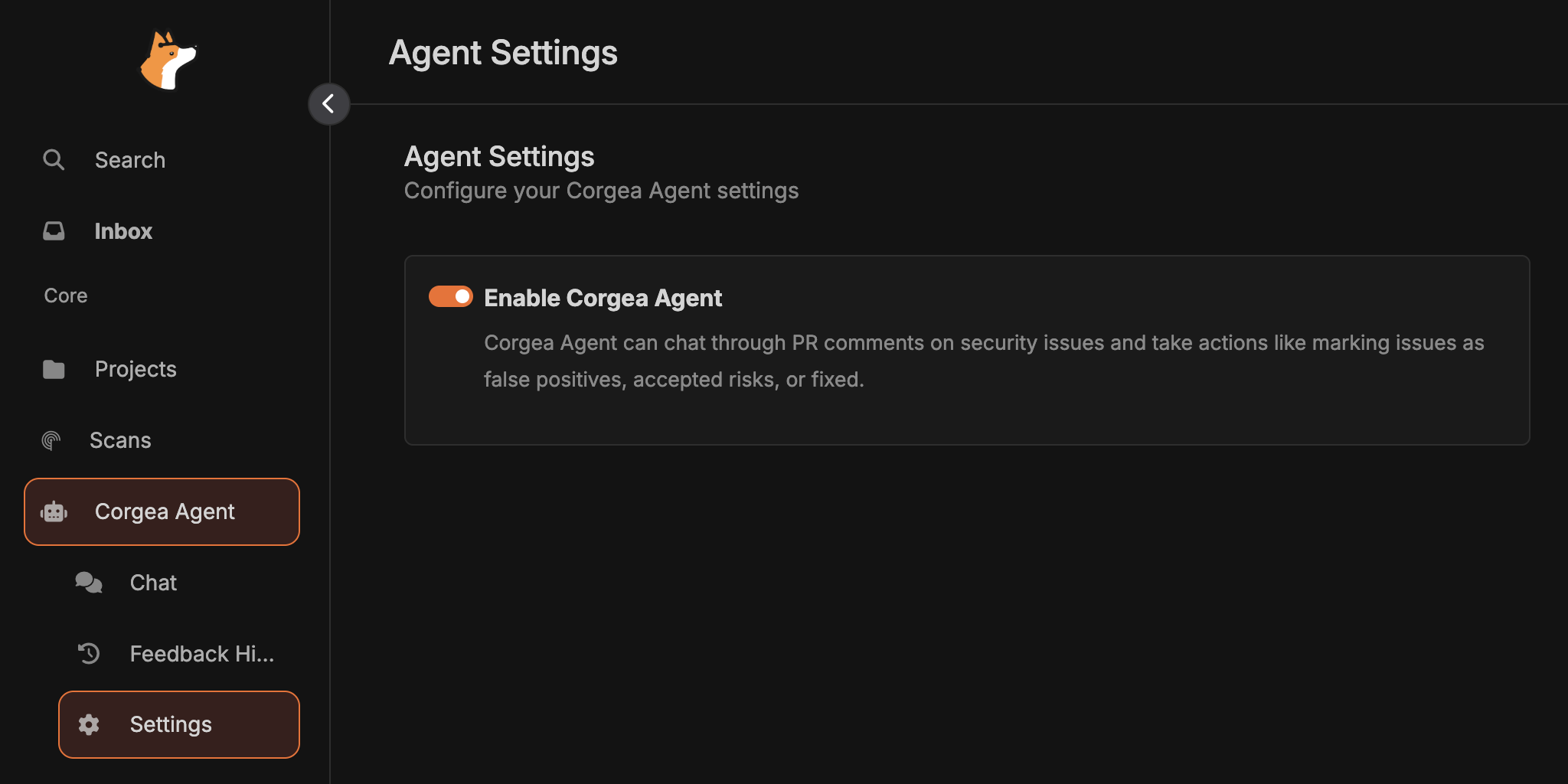
Navigate to **Settings > Agent Settings** in your Corgea dashboard and toggle the "Enable Corgea Agent" switch to activate the agent. Once enabled, the agent will begin monitoring PR comments and be available for chat.
 Ensure your Corgea integration has necessary permissions to:
* Read pull request comments
* Post comments on pull requests
* Access repository content
Check your integration settings to confirm webhooks are active.
* Create a test PR with a security issue
* Comment `hello` on any vulnerability in the PR to verify the agent responds
* Access the web chat interface to ask a question about your scans
***
## Web Chat Interface
### Accessing the Chat
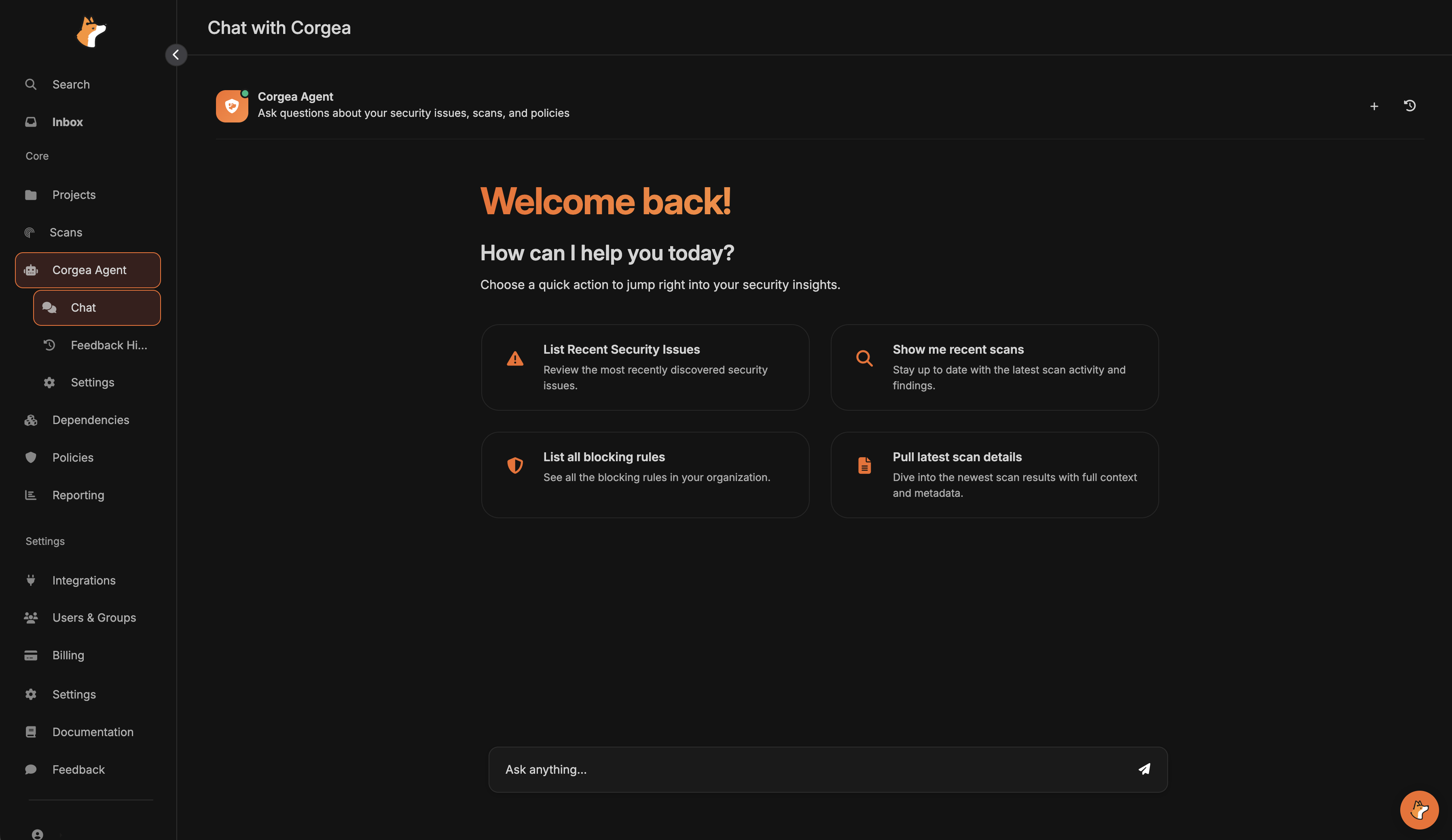
Navigate to the **Chat** section in your Corgea dashboard to access the interactive AI assistant.
Ensure your Corgea integration has necessary permissions to:
* Read pull request comments
* Post comments on pull requests
* Access repository content
Check your integration settings to confirm webhooks are active.
* Create a test PR with a security issue
* Comment `hello` on any vulnerability in the PR to verify the agent responds
* Access the web chat interface to ask a question about your scans
***
## Web Chat Interface
### Accessing the Chat
Navigate to the **Chat** section in your Corgea dashboard to access the interactive AI assistant.
 ### What You Can Do
The Corgea Agent has deep knowledge of your security posture and can help you:
Get detailed information about specific vulnerabilities, understand severity levels, and review fix suggestions
Review scan results and summaries, compare scans over time, and understand scan coverage
List issues by severity, project, or type, and review blocking rules and policy violations
### Example Queries
```plaintext Example Chat Queries theme={null}
"Show me all critical issues in my latest scan"
"What are the details for issue abc-123?"
"List all SQL injection vulnerabilities in project XYZ"
"Explain the security implications of CVE-2024-12345"
"What blocking rules are currently active?"
```
### What You Can Do
The Corgea Agent has deep knowledge of your security posture and can help you:
Get detailed information about specific vulnerabilities, understand severity levels, and review fix suggestions
Review scan results and summaries, compare scans over time, and understand scan coverage
List issues by severity, project, or type, and review blocking rules and policy violations
### Example Queries
```plaintext Example Chat Queries theme={null}
"Show me all critical issues in my latest scan"
"What are the details for issue abc-123?"
"List all SQL injection vulnerabilities in project XYZ"
"Explain the security implications of CVE-2024-12345"
"What blocking rules are currently active?"
```
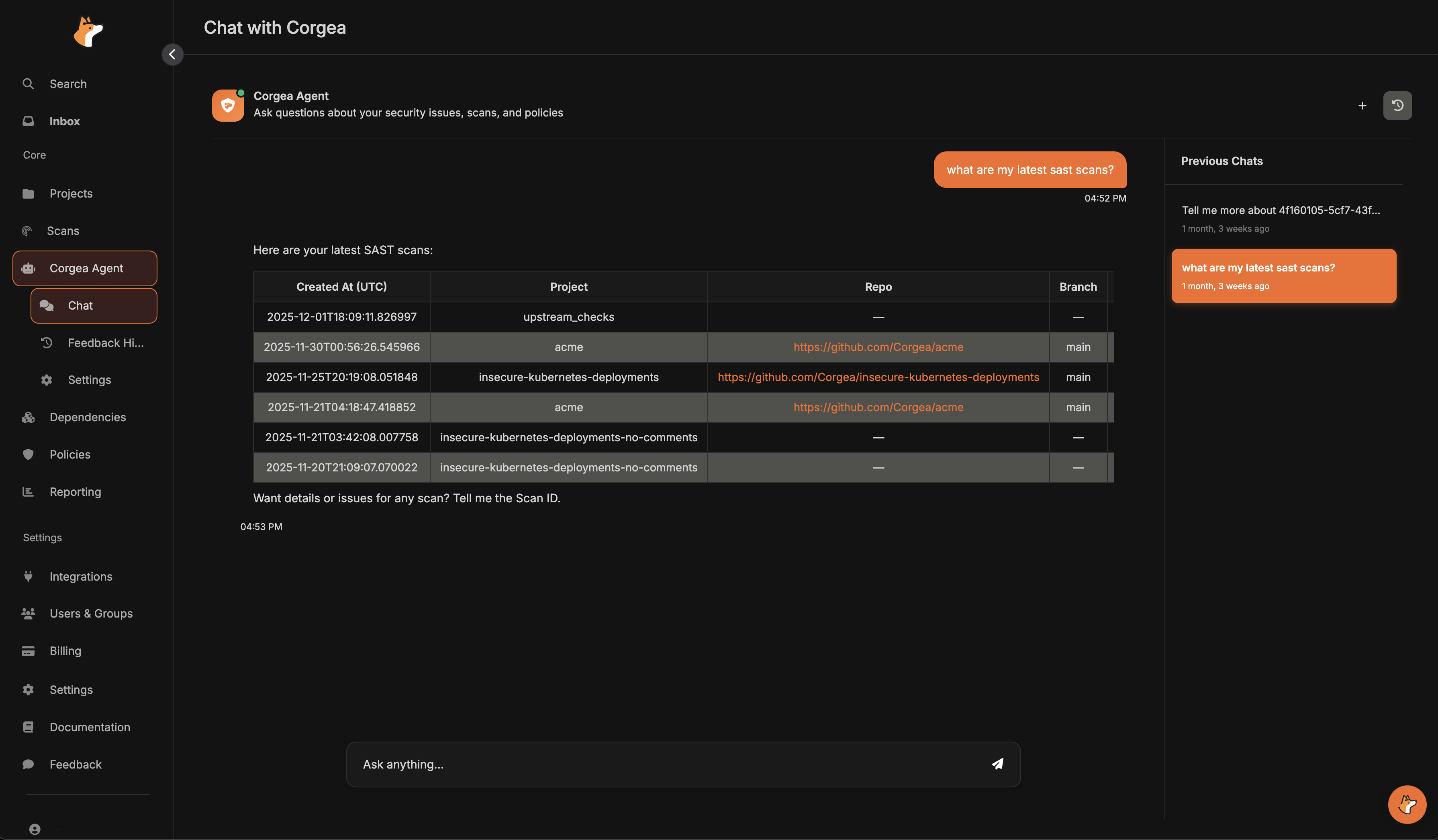 Be specific in your queries for better results. Reference issue IDs, scan IDs, or project names directly for more accurate responses.
***
## Pull Request Interactions
### How It Works
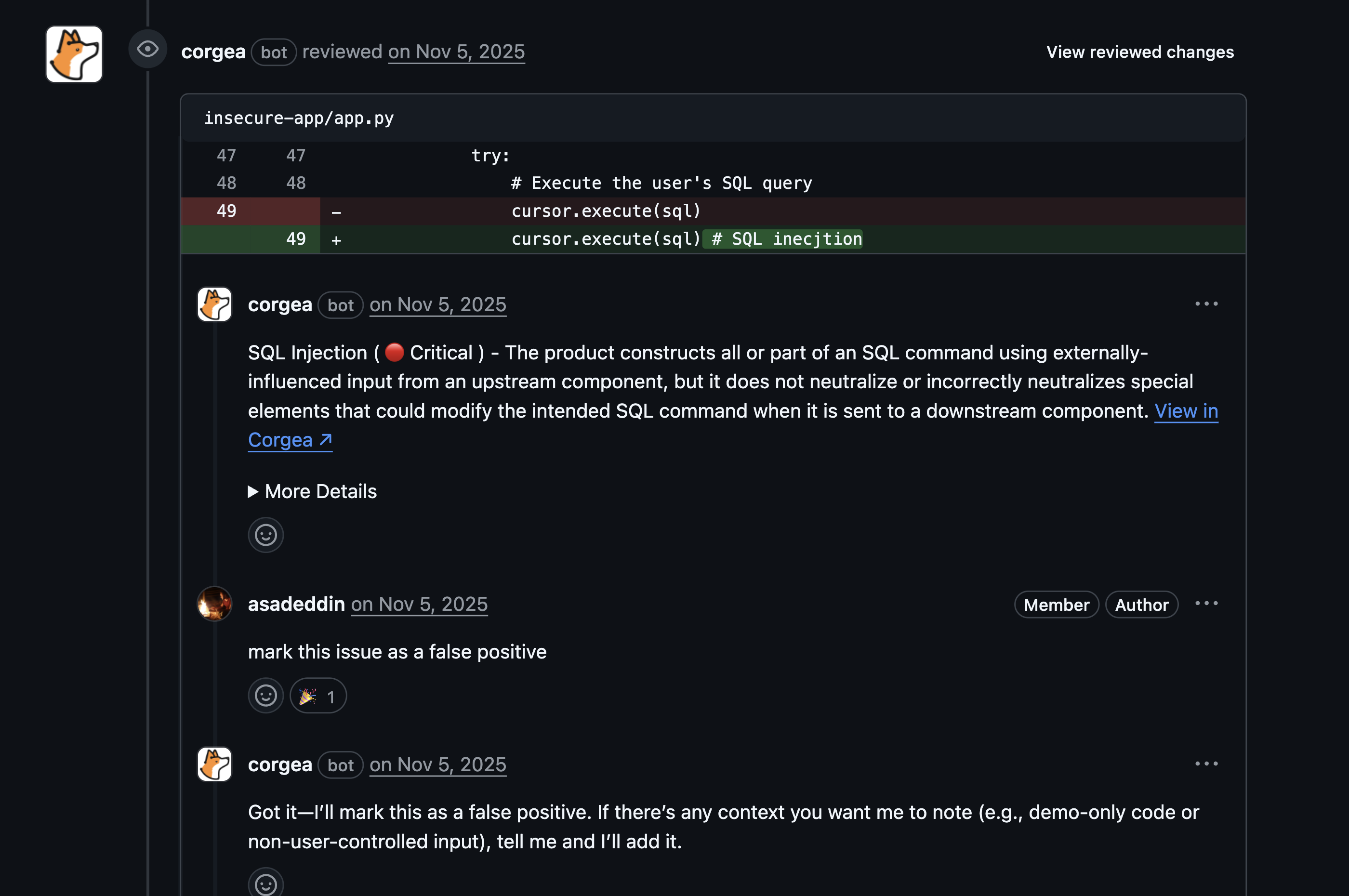
When Corgea detects security issues in a pull request, the agent automatically:
1. Posts comments highlighting the vulnerabilities
2. Monitors the PR for developer responses
3. Interprets developer intent from comments
4. Takes automated actions based on commands
Be specific in your queries for better results. Reference issue IDs, scan IDs, or project names directly for more accurate responses.
***
## Pull Request Interactions
### How It Works
When Corgea detects security issues in a pull request, the agent automatically:
1. Posts comments highlighting the vulnerabilities
2. Monitors the PR for developer responses
3. Interprets developer intent from comments
4. Takes automated actions based on commands
 ### Triggering the Agent
The agent responds to comments that:
* Explicitly mention `@Corgea`
* Reply directly to Corgea's issue comment
* Contain recognizable action commands
* Are directed at addressing security findings
You don't need to use `@Corgea` as the agent will respond to comments to it's own.
### Supported Actions
Indicate that a reported issue is not actually a vulnerability.
**Example Comments:**
```plaintext theme={null}
@Corgea false positive
This is not a real issue, it's a false positive
@Corgea this is safe code
```
**What Happens:**
* Issue is marked as "False Positive"
* Issue is removed from blocking status
* Feedback is recorded for analysis
Acknowledge a real vulnerability but accept the risk without immediate remediation.
**Example Comments:**
```plaintext theme={null}
@Corgea accept risk
We accept this risk for now
@Corgea low priority, won't fix
This is acceptable for our use case
```
**What Happens:**
* Issue status changes to "Accepted Risk"
* Issue no longer blocks PR
* Risk acceptance is logged
Confirm that a vulnerability has been resolved.
**Example Comments:**
```plaintext theme={null}
@Corgea fixed
Already fixed this in the latest commit
@Corgea this is resolved
```
**What Happens:**
* Issue status changes to "Fixed"
* Issue no longer appears in active findings
* Fix confirmation is recorded
Flag an issue as a duplicate of an existing finding.
**Example Comments:**
```plaintext theme={null}
@Corgea duplicate
This is a duplicate of issue XYZ
Same as #456
```
**What Happens:**
* Issue is marked as duplicate
* Linked to original issue (if specified)
* Removed from active count
Indicate that work is underway to fix the issue.
**Example Comments:**
```plaintext theme={null}
@Corgea fix in progress
Working on this now
We're fixing this in the next commit
```
**What Happens:**
* Issue status changes to "Fix In Progress"
* Tracked as actively being addressed
* Team can monitor progress
Ask Corgea for additional details about a vulnerability.
**Example Comments:**
```plaintext theme={null}
@Corgea explain this issue
What's the security impact here?
Can you provide more context?
```
**What Happens:**
* Agent provides detailed explanation
* Includes vulnerability context and remediation guidance
* May suggest related resources
### Comment Interaction Examples
**Scenario:** Developer disagrees with finding
```plaintext PR Comment theme={null}
This input is already sanitized in the middleware layer, false positive
```
**Agent Response:**
```plaintext theme={null}
✅ Marked as False Positive
This issue has been marked as a false positive based on your feedback.
The issue will no longer block this PR.
```
**Scenario:** Accepting risk for legacy code
```plaintext PR Comment theme={null}
This is legacy code we're deprecating next quarter. Accept the risk
```
**Agent Response:**
```plaintext theme={null}
⚠️ Marked as Accepted Risk
This issue has been acknowledged as an accepted risk.
It will no longer block this PR, but will remain in your security dashboard for tracking.
```
**Scenario:** Developer needs clarification
```plaintext PR Comment theme={null}
Can you explain why this is considered an SQL injection vulnerability?
```
**Agent Response:**
```plaintext theme={null}
[Detailed explanation of the SQL injection risk,
code examples, and suggested remediation approaches]
```
### Feedback History
View all PR comment interactions in the **Feedback History** section:
* See all actions taken via PR comments
* Open an entry to view the original comment, AI reasoning, and the agent response in one place
* Filter by action type, user, or date range
* Monitor team engagement with security findings
### Triggering the Agent
The agent responds to comments that:
* Explicitly mention `@Corgea`
* Reply directly to Corgea's issue comment
* Contain recognizable action commands
* Are directed at addressing security findings
You don't need to use `@Corgea` as the agent will respond to comments to it's own.
### Supported Actions
Indicate that a reported issue is not actually a vulnerability.
**Example Comments:**
```plaintext theme={null}
@Corgea false positive
This is not a real issue, it's a false positive
@Corgea this is safe code
```
**What Happens:**
* Issue is marked as "False Positive"
* Issue is removed from blocking status
* Feedback is recorded for analysis
Acknowledge a real vulnerability but accept the risk without immediate remediation.
**Example Comments:**
```plaintext theme={null}
@Corgea accept risk
We accept this risk for now
@Corgea low priority, won't fix
This is acceptable for our use case
```
**What Happens:**
* Issue status changes to "Accepted Risk"
* Issue no longer blocks PR
* Risk acceptance is logged
Confirm that a vulnerability has been resolved.
**Example Comments:**
```plaintext theme={null}
@Corgea fixed
Already fixed this in the latest commit
@Corgea this is resolved
```
**What Happens:**
* Issue status changes to "Fixed"
* Issue no longer appears in active findings
* Fix confirmation is recorded
Flag an issue as a duplicate of an existing finding.
**Example Comments:**
```plaintext theme={null}
@Corgea duplicate
This is a duplicate of issue XYZ
Same as #456
```
**What Happens:**
* Issue is marked as duplicate
* Linked to original issue (if specified)
* Removed from active count
Indicate that work is underway to fix the issue.
**Example Comments:**
```plaintext theme={null}
@Corgea fix in progress
Working on this now
We're fixing this in the next commit
```
**What Happens:**
* Issue status changes to "Fix In Progress"
* Tracked as actively being addressed
* Team can monitor progress
Ask Corgea for additional details about a vulnerability.
**Example Comments:**
```plaintext theme={null}
@Corgea explain this issue
What's the security impact here?
Can you provide more context?
```
**What Happens:**
* Agent provides detailed explanation
* Includes vulnerability context and remediation guidance
* May suggest related resources
### Comment Interaction Examples
**Scenario:** Developer disagrees with finding
```plaintext PR Comment theme={null}
This input is already sanitized in the middleware layer, false positive
```
**Agent Response:**
```plaintext theme={null}
✅ Marked as False Positive
This issue has been marked as a false positive based on your feedback.
The issue will no longer block this PR.
```
**Scenario:** Accepting risk for legacy code
```plaintext PR Comment theme={null}
This is legacy code we're deprecating next quarter. Accept the risk
```
**Agent Response:**
```plaintext theme={null}
⚠️ Marked as Accepted Risk
This issue has been acknowledged as an accepted risk.
It will no longer block this PR, but will remain in your security dashboard for tracking.
```
**Scenario:** Developer needs clarification
```plaintext PR Comment theme={null}
Can you explain why this is considered an SQL injection vulnerability?
```
**Agent Response:**
```plaintext theme={null}
[Detailed explanation of the SQL injection risk,
code examples, and suggested remediation approaches]
```
### Feedback History
View all PR comment interactions in the **Feedback History** section:
* See all actions taken via PR comments
* Open an entry to view the original comment, AI reasoning, and the agent response in one place
* Filter by action type, user, or date range
* Monitor team engagement with security findings
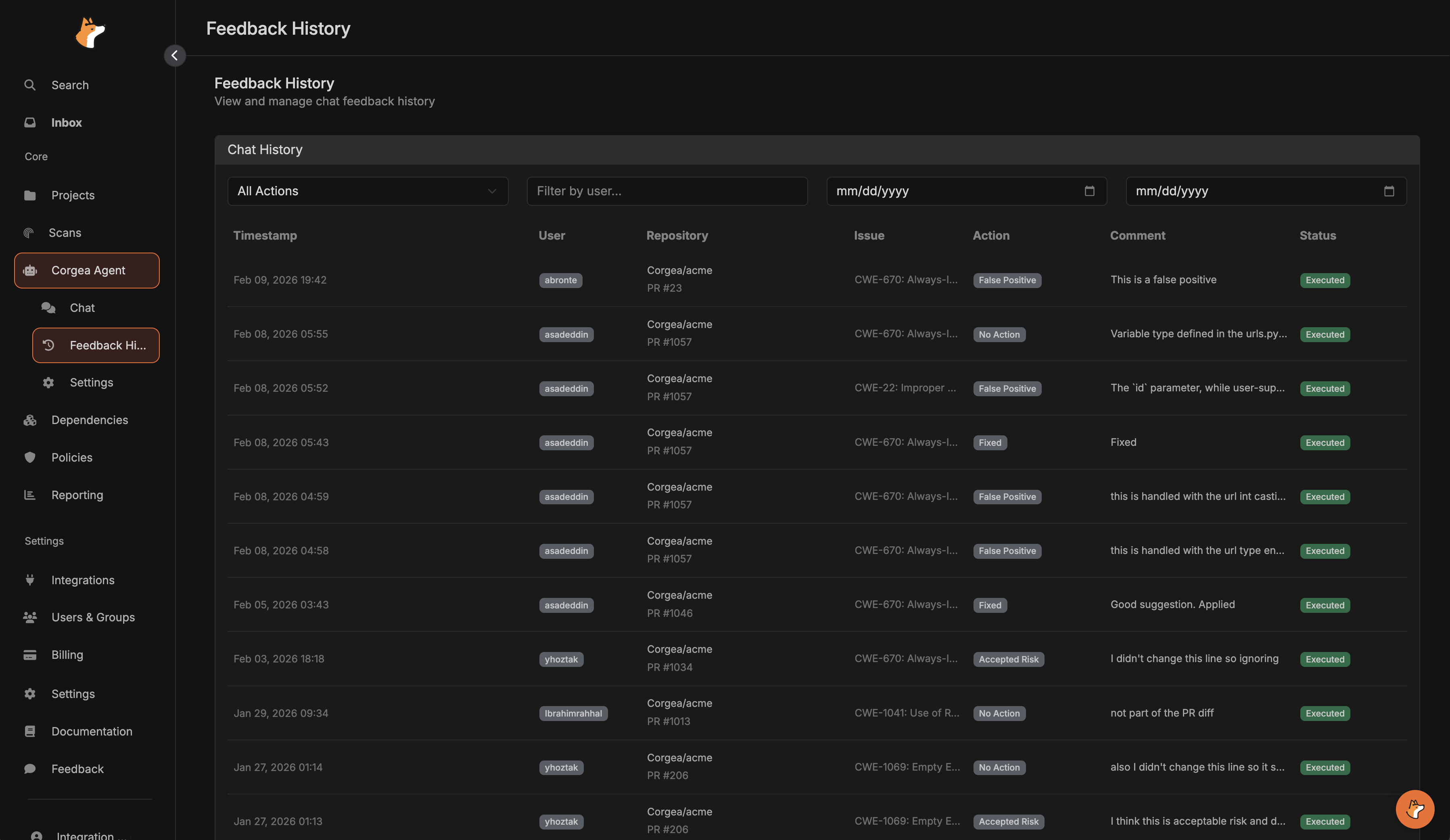 **Available Filters:**
* Action Type (False Positive, Accepted Risk, Fixed, etc.)
* GitHub/GitLab/Azure DevOps user
* Date range
***
## Supported Platforms
Corgea Agent works seamlessly across multiple development platforms:
* Pull request comments
* Issue comments
* Review threads
Requires: GitHub App installation with appropriate permissions
* Merge request comments
* Note threads
Requires: GitLab integration with webhook configuration
Requires: Support is coming soon
* Pull request comments
* Inline discussions
Requires: Bitbucket integration with webhook configuration
***
## Troubleshooting
**Check:**
* Is the agent enabled in Settings > Agent Settings?
* Are webhooks properly configured for your repository?
* Did you mention `@Corgea` or reply to an agent comment?
* Is your integration active and properly authenticated?
**Solution:**
* Verify webhook delivery in your platform's webhook settings
* Check integration status in Corgea dashboard
* Re-authenticate if needed
**Check:**
* Does your comment clearly state the intended action?
* Are you commenting on the correct issue?
* Do you have permissions to modify issues?
**Solution:**
* Use explicit commands like "@Corgea false positive"
* Check the Feedback History to see how your comment was interpreted
**Check:**
* Browser console for JavaScript errors
* Network connectivity
* Account permissions
**Solution:**
* Refresh the page
* Clear browser cache
* Contact support if issue persists
***
## Best Practices
**One Action Per Comment**: Keep comments focused on a single action
**Provide Context**: Add reasoning to help the team understand your decision
**Review Feedback History**: Periodically check how your commands are interpreted
**Use Specific Identifiers**: Reference issue IDs, scan IDs, or project names
**Ask Follow-Up Questions**: Drill deeper into topics with contextual queries
**Leverage Search**: Filter results by severity, type, or status
**Save Important Queries**: Keep track of useful queries for recurring analysis
***
## Privacy & Security
All chat interactions are scoped to your company's data. The agent only accesses information your user account has permission to view.
* PR comment actions are logged and auditable in Feedback History
* Agent responses never expose sensitive credentials or internal implementation details
* Data is processed in compliance with Corgea's security standards
***
## Support
Need help with Corgea Agent? Contact us at [support@corgea.com](mailto:support@corgea.com)
**Available Filters:**
* Action Type (False Positive, Accepted Risk, Fixed, etc.)
* GitHub/GitLab/Azure DevOps user
* Date range
***
## Supported Platforms
Corgea Agent works seamlessly across multiple development platforms:
* Pull request comments
* Issue comments
* Review threads
Requires: GitHub App installation with appropriate permissions
* Merge request comments
* Note threads
Requires: GitLab integration with webhook configuration
Requires: Support is coming soon
* Pull request comments
* Inline discussions
Requires: Bitbucket integration with webhook configuration
***
## Troubleshooting
**Check:**
* Is the agent enabled in Settings > Agent Settings?
* Are webhooks properly configured for your repository?
* Did you mention `@Corgea` or reply to an agent comment?
* Is your integration active and properly authenticated?
**Solution:**
* Verify webhook delivery in your platform's webhook settings
* Check integration status in Corgea dashboard
* Re-authenticate if needed
**Check:**
* Does your comment clearly state the intended action?
* Are you commenting on the correct issue?
* Do you have permissions to modify issues?
**Solution:**
* Use explicit commands like "@Corgea false positive"
* Check the Feedback History to see how your comment was interpreted
**Check:**
* Browser console for JavaScript errors
* Network connectivity
* Account permissions
**Solution:**
* Refresh the page
* Clear browser cache
* Contact support if issue persists
***
## Best Practices
**One Action Per Comment**: Keep comments focused on a single action
**Provide Context**: Add reasoning to help the team understand your decision
**Review Feedback History**: Periodically check how your commands are interpreted
**Use Specific Identifiers**: Reference issue IDs, scan IDs, or project names
**Ask Follow-Up Questions**: Drill deeper into topics with contextual queries
**Leverage Search**: Filter results by severity, type, or status
**Save Important Queries**: Keep track of useful queries for recurring analysis
***
## Privacy & Security
All chat interactions are scoped to your company's data. The agent only accesses information your user account has permission to view.
* PR comment actions are logged and auditable in Feedback History
* Agent responses never expose sensitive credentials or internal implementation details
* Data is processed in compliance with Corgea's security standards
***
## Support
Need help with Corgea Agent? Contact us at [support@corgea.com](mailto:support@corgea.com)